Using Policy as a Strategy for Systems Change
Keywords:
Systems Change, Public Policy, Cross-Sector Collaboration, Ecosystem Governance, Housing Stability, Workforce Development, Behavioral Health, Prevention and Early Intervention, Community Wellbeing, Economic Mobility, Integrated Service DeliveryAbstract
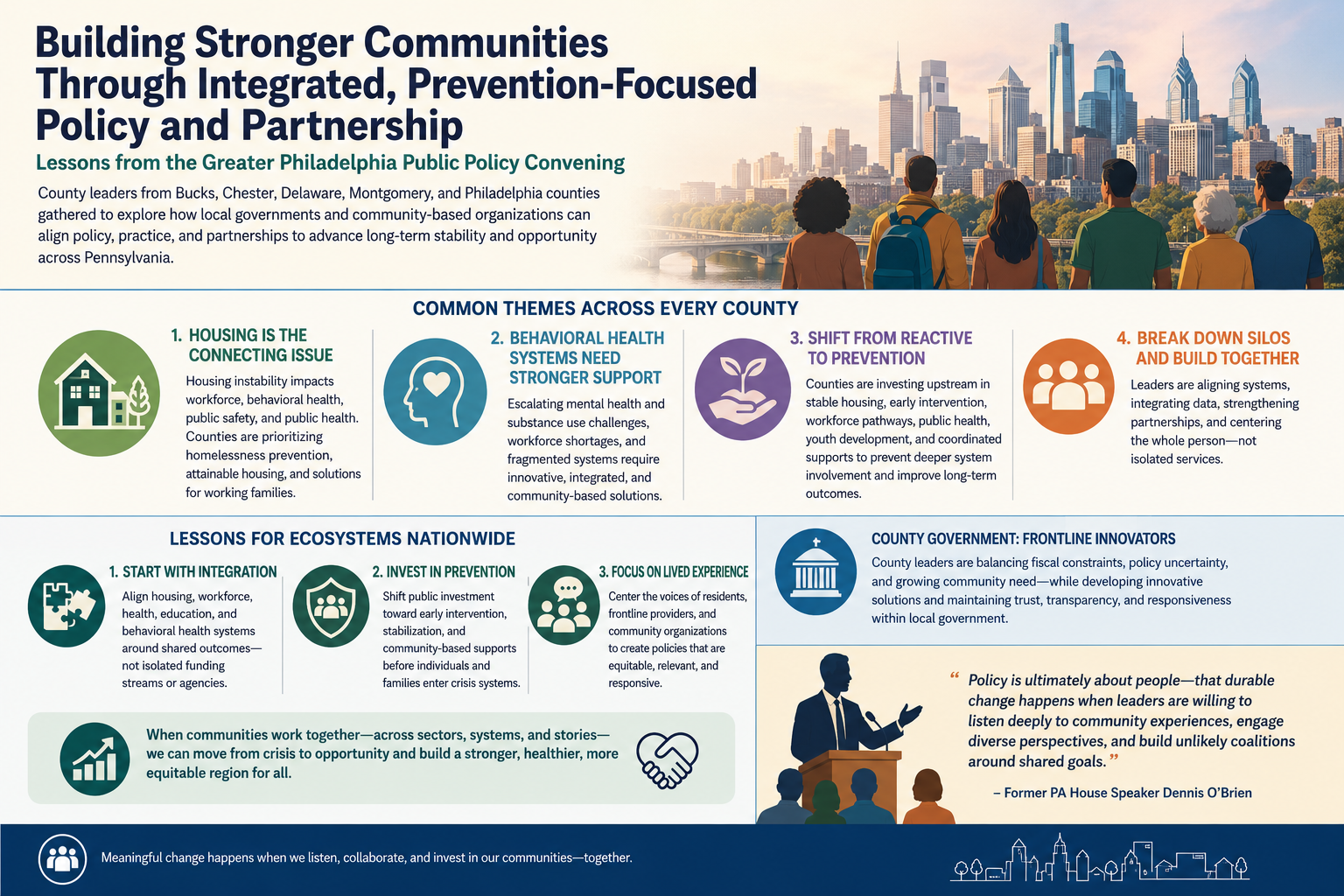
Across the Greater Philadelphia region, county governments, nonprofit leaders, healthcare systems, educational institutions, workforce organizations, and community advocates are confronting challenges that are deeply interconnected. Housing instability influences educational attainment. Behavioral health gaps contribute to workforce disruptions. Workforce shortages strain healthcare and human services systems. Fragmented systems leave vulnerable residents navigating disconnected services with inconsistent outcomes.
What emerged from the recent Greater Philadelphia policy convenings and public policy fellowship briefs is a powerful realization: these are not isolated county problems. They are ecosystem problems.
The policy recommendations advanced across Bucks, Chester, Delaware, Montgomery, and Philadelphia counties collectively demonstrate that Greater Philadelphia functions as one regional ecosystem. Residents cross county borders for employment, healthcare, transportation, housing, education, and social services every day. Economic mobility in Philadelphia impacts workforce stability in Chester County. Housing shortages in Montgomery County affect labor pipelines in Bucks County. Behavioral health capacity gaps in Delaware County create pressures across hospital systems regionally.
Most importantly, the region’s challenges mirror those facing metropolitan ecosystems throughout the United States and increasingly across the globe. Whether in Pennsylvania, California, Texas, Canada, Europe, or rapidly urbanizing regions worldwide, communities are grappling with the same core tensions:
- Fragmented systems operating independently rather than collaboratively
- Housing instability undermining economic mobility
- Workforce shortages in healthcare, behavioral health, long-term care, education, and skilled trades
- Rising behavioral health needs
- Youth disengagement from traditional pathways to economic opportunity
- Service delivery systems that remain reactive instead of preventative
- Institutional structures that struggle to integrate community voice and lived experience
The published policy briefs developed, through a 6-modular process and formal training, by 16 Policy Fellows and supported by Tabor Services Foundation offer not simply local recommendations, but scalable frameworks for ecosystems seeking to use policy as a tool for long-term systems change.
Together, these recommendations reveal an emerging blueprint for ecosystem transformation grounded in prevention, integration, stabilization, and community-centered policymaking.
Downloads
Published
How to Cite
Issue
Section
Categories
License
Copyright (c) 2026 Nicholas Torres (Author)

This work is licensed under a Creative Commons Attribution-NonCommercial-NoDerivatives 4.0 International License.
The Social Innovations Journal permits the Creative Commons License:
CC Attribution-NonCommercial-NoDerivatives 4.0
Under the following terms:
-
Attribution — You must give appropriate credit, provide a link to the license, and indicate if changes were made. You may do so in any reasonable manner, but not in any way that suggests the licensor endorses you or your use.
-
NonCommercial — You may not use the material for commercial purposes.
-
NoDerivatives — If you remix, transform, or build upon the material, you may not distribute the modified material.
- No additional restrictions — You may not apply legal terms or technological measures that legally restrict others from doing anything the license permits.
Notices:
- You do not have to comply with the license for elements of the material in the public domain or where your use is permitted by an applicable exception or limitation.
- No warranties are given. The license may not give you all of the permissions necessary for your intended use. For example, other rights such as publicity, privacy, or moral rights may limit how you use the material
Copyright and Publishing Rights
For the licenses indicated above, authors retain the copyright and full publishing rights without restrictions.