
Vol. 36 (2026): Public Policy Innovations for Equitable Communities
Dear Reader,
Across the Greater Philadelphia region, county leaders, policymakers, nonprofit organizations, health and human service professionals, advocates, and community stakeholders are confronting a shared reality: the systems designed to support health, housing, workforce mobility, and community wellbeing are under extraordinary strain. Yet amid these challenges, there is also a growing regional consensus that meaningful change is possible when communities move beyond fragmented, crisis-driven responses and embrace integrated, prevention-focused strategies.
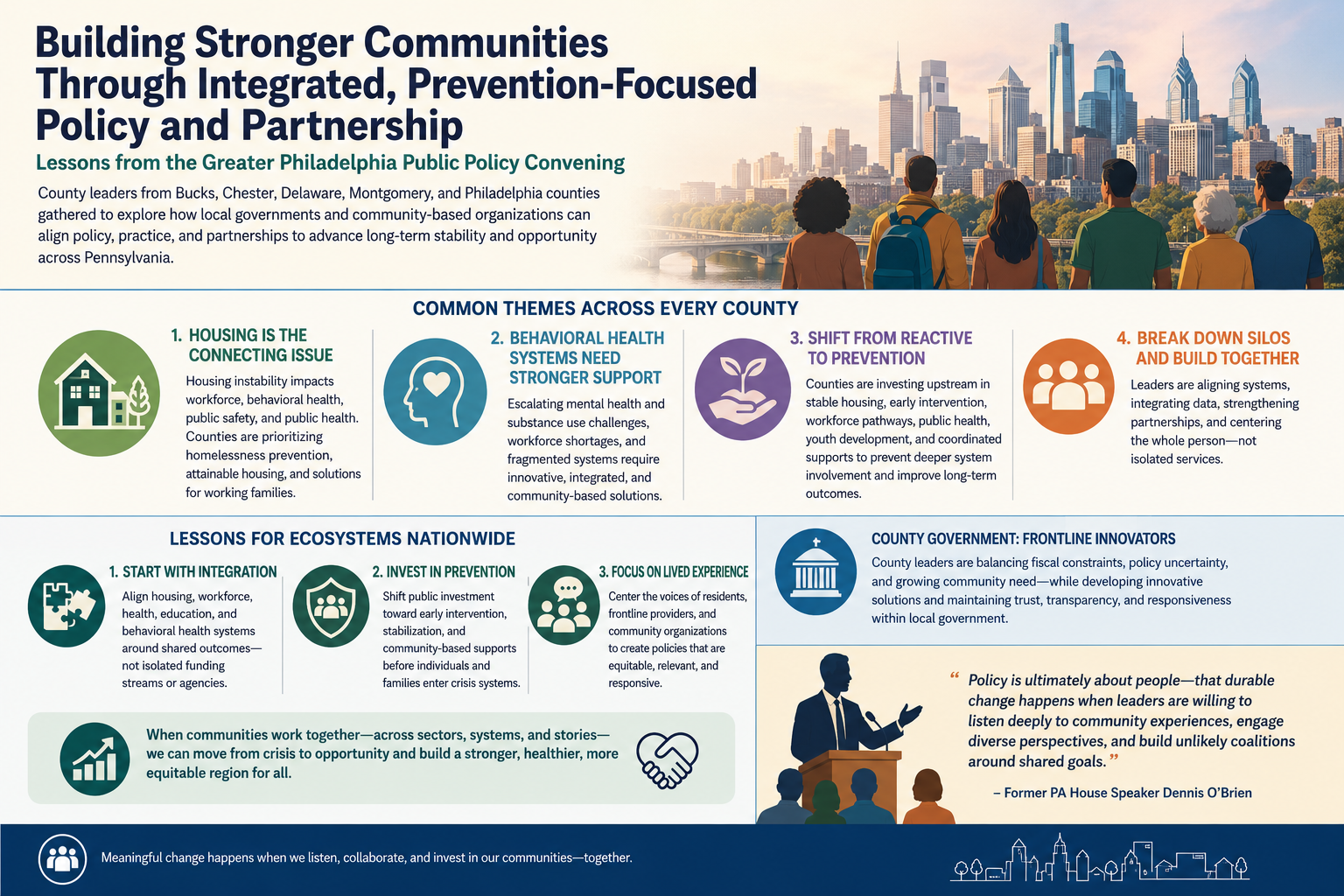
This edition of Social Innovations Journal emerges from the conversations and policy discussions held during the Greater Philadelphia Public Policy Convening at Woods System of Care supported by the Tabor Services Foundation. The convening brought together leadership from Bucks, Chester, Delaware, Montgomery, and Philadelphia counties to explore how local governments and community-based organizations can align policy, practice, and partnerships to advance long-term stability and opportunity across Pennsylvania.
While each county faces unique demographic, geographic, and economic realities, several common themes emerged powerfully across every discussion.
First, housing has become the defining policy issue connecting nearly every other system challenge. County leaders repeatedly emphasized that housing instability is no longer solely a housing issue—it is a workforce issue, a behavioral health issue, a public safety issue, and a public health issue. Counties described growing concerns around homelessness prevention, attainable housing for working families, rising displacement pressures, and the inability of critical workforce sectors to recruit and retain employees who can afford to live in the communities they serve.
Second, behavioral health systems remain significantly under-resourced at a time when communities are experiencing increasing complexity and acuity of need. Leaders across counties described escalating mental health and substance use challenges, particularly post-pandemic, while simultaneously navigating workforce shortages and fragmented service systems. Yet the conversations also reflected optimism around innovative crisis diversion programs, integrated behavioral health models, and community-based prevention strategies designed to reduce reliance on emergency rooms, incarceration, and institutional care.
Third, nearly every county emphasized the need to shift from reactive systems toward upstream prevention. The language of “moving from crisis to prevention” became a recurring regional theme. Counties discussed the importance of investing earlier—in stable housing, early intervention services, workforce pathways, public health infrastructure, youth development, and coordinated community supports—to prevent deeper system involvement later. This philosophy reflects an important evolution in public policy thinking: recognizing that sustainable community wellbeing requires addressing root causes rather than continuously responding to downstream emergencies.
Another clear message from county leadership was that communities can no longer afford siloed systems. Whether discussing housing, health care, behavioral health, workforce development, criminal justice reform, or economic mobility, leaders consistently highlighted the importance of cross-sector coordination and integrated policymaking. Residents do not experience their lives through separate bureaucratic systems; they experience housing instability, transportation barriers, workforce challenges, and health needs simultaneously. Effective policy must therefore be designed around people, not agencies. Several counties described efforts to align departments, integrate data, strengthen partnerships, and build collaborative models that center the “whole person” rather than isolated services.
The convening also reinforced the critical role that county governments increasingly play as frontline system innovators. Counties are often where federal policy changes, state funding decisions, and community realities intersect most directly. As federal and state policy volatility continues to create uncertainty around housing, Medicaid, workforce investments, and human services funding, county leaders are being asked to stabilize systems while simultaneously innovating under pressure. Many described balancing fiscal constraints with growing community need, while also working to preserve trust, transparency, and responsiveness within local government.
Importantly, the discussions throughout the convening underscored that policy change does not happen in isolation. Again and again, speakers emphasized that meaningful systems transformation requires relationships, trust, listening, and storytelling. Former Pennsylvania House Speaker Dennis O’Brien reminded attendees that policy is ultimately about people—that durable change happens when leaders are willing to listen deeply to community experiences, engage diverse perspectives, and build unlikely coalitions around shared goals.
For ecosystems across the country seeking to use policy as a strategy for change, several lessons emerged from this regional dialogue. 1) Start with integration. Communities must intentionally align housing, workforce, health, education, and behavioral health systems around shared outcomes rather than isolated funding streams or agency structures. 2) Invest in prevention. Long-term sustainability requires shifting public investment toward early intervention, stabilization, and community-based supports before individuals and families enter crisis systems. 3) Focus on lived experience. The most effective policy solutions are informed directly by residents, frontline providers, and community organizations who understand both the barriers and opportunities within local systems. 4) Build cross-sector coalitions. Lasting policy change requires collaboration among government, philanthropy, nonprofit organizations, health systems, educational institutions, and community advocates. 5) Focus on measurable outcomes, not activity alone. Counties increasingly emphasized the need to move beyond counting services delivered toward measuring whether systems are truly improving long-term stability, mobility, and wellbeing. 6) Finally, trust matters. Communities are more likely to engage with systems that are transparent, collaborative, accountable, and visibly connected to the people they serve.
We encourage you to read the policy briefs in this edition of Social Innovations Journal, as the recommendations can apply to any ecosystem.
FROM STABILITY TO MOBILITY: BUILDING INTEGRATED PATHWAYS TO ECONOMIC OPPORTUNITY IN PENNSYLVANIA.
- Building Pennsylvania’s Youth-to-Career Pipeline: Aligning Education, Apprenticeships, Housing Stabilization, and Workforce Systems: David Weathington, Jobs for American Graduates Pennsylvania
- Public Sector Apprenticeships as an Economic Mobility and Workforce Solution: Aubrey D'Angelo, Montgomery County
- Advocating for Positive Rent Reporting: Jill Roberts, Clarifi
- Raising Eviction Filings Fees to Reduce Evictions in Pennsylvania: Scout Frost and Kasey Schlack, Chester County Department of Community Development
- Perpetual Affordability in Future Low-Income Housing Tax Credit (LIHTC) Allocations: Abigail Hastings, Independent and Haley Kulp, The Foundation for Delaware County
- Amend the PA Real Estate Transfer tax to provide counties funding for homelessness and housing instability response: Katelyn Blair Marseglia, Bucks County: Division of Human Services
FROM ACCESS TO PREVENTION: BUILDING A PROACTIVE, EQUITABLE HEALTH SYSTEM IN PENNSYLVANIA
- Advocating for increased support to families enrolled in Medicaid to mitigate the effects of HR1 on children’s access to healthcare: Mary Lauren Salvatore, Education Plus Health
- Reimagining EPSDT: A Public Health Strategy to Prevent Crisis and End Systemic Invisibility of Non-Apparent Disabilities: Jennifer Marazzo w/ Eric Fishon, Woods Services
- Breaking the Cycle of Addiction: Investing in Early Prevention Efforts to Mitigate Addiction Before It Starts: Emily Hernandez, Salem Health and Wellness Foundation
- Support County Adoption of a Community Health Worker credentialing and role standardization policy: Moira Gassenmeyer, Alliance for Health Equity and Janielle Bryan, FPCN
- Delaware County Overburdened Communities Clean Air Protection Ordinance: Kristin Motley, City of Chester, Bureau of Health
FROM CRISIS SYSTEMS TO COMMUNITY SYSTEMS: REBUILDING CARE, STABILITY, AND SUSTAINABILITY IN PENNSYLVANIA
- Establishing Intensive Step-Down Community Residences for Adults with Co-Occurring Intellectual Disability and Mental Health Needs in Pennsylvania: Jordan Hollander, Woods System of Care
- Strengthening Pennsylvania Home and Community Services for People with Intellectual and Developmental Disabilities: Babra Mendez, Brian’s House
- Advocating for Delaware County Central Booking Room and Support: Nathan Orians, Delaware County Office of the Public Defender
- Establishing a Philadelphia Organic Waste Reduction and Edible Food Recovery Ordinance: Linda T. James-Rivera, Northwest Mutual Aid Collective
- Adverse Possession Reduced to 5 Years for Community Gardens/Urban Farms: Jovian Patterson, Original American Foundation
The work ahead will not be easy. Yet the conversations captured in this edition demonstrate that counties and communities across the Greater Philadelphia region are already building models of collaborative leadership capable of informing policy innovation far beyond Pennsylvania. The future of social innovation will depend not simply on new programs, but on our collective ability to redesign systems around dignity, prevention, integration, and opportunity.
We hope the ideas, policies, and partnerships highlighted in this edition inspire leaders across sectors to continue building resilient, equitable, and community-centered systems that create lasting change.
Sincerely,
Karen Coleman, President, Tabor Services Foundation
Tine Hansen-Turton, Chair, Tabor Services Foundation and CEO, Woods System of Care
Nicholas Torres, Publisher
Published:
2026-06-04