
Vol. 33 (2025): Social Innovations Towards Leadership Excellence
Dear Reader,
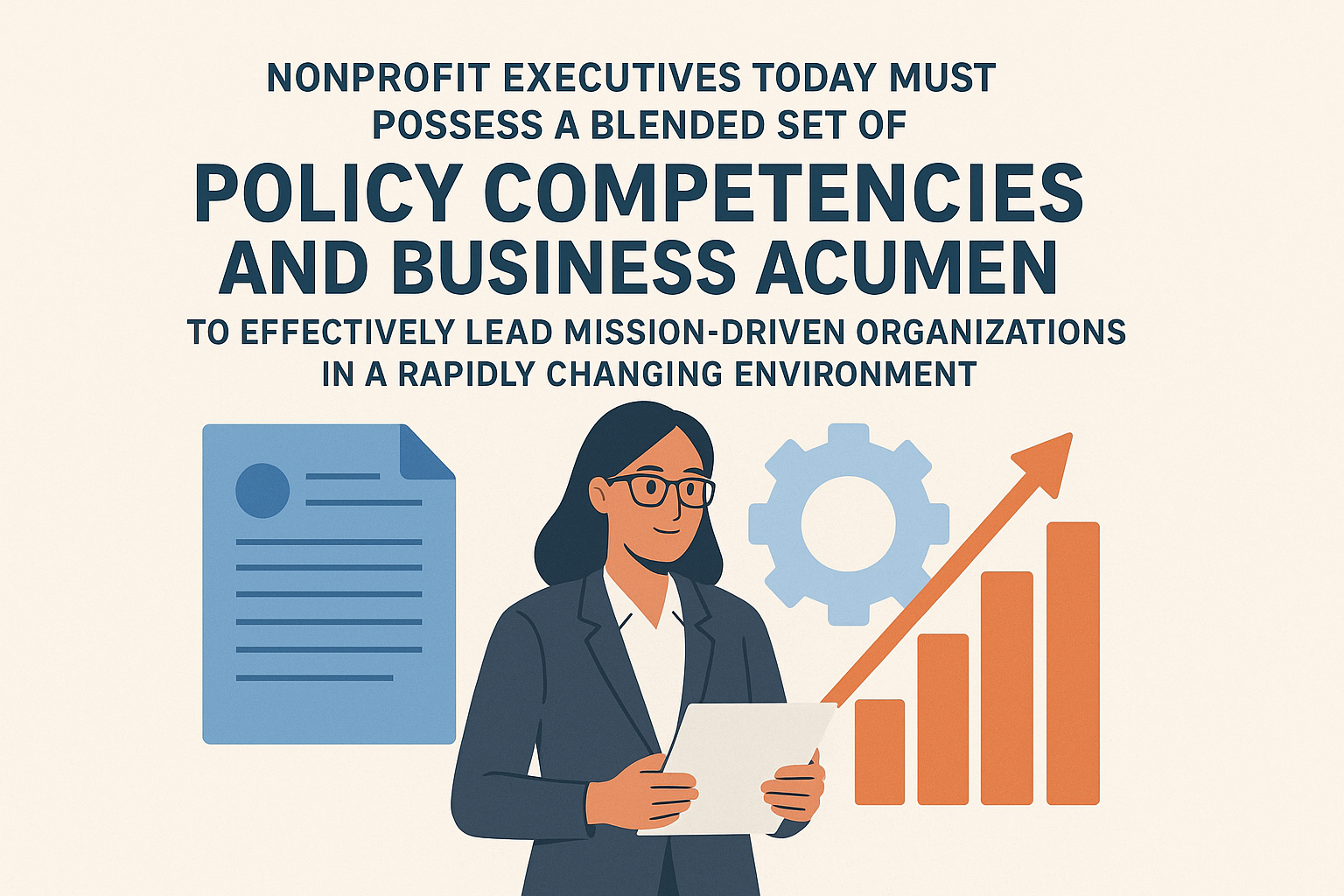
Nonprofit executives today must possess a blended set of policy competencies and business acumen to lead mission-driven organizations effectively in a rapidly changing environment.
On the policy side, leaders need to be fluent in systems thinking, policy analysis, and stakeholder mapping to translate on-the-ground needs into persuasive policy briefs, testimony, and tactical advocacy plans. They must also know how to build coalitions, engage community voices, and anticipate the unintended consequences of policy proposals. Recent research and practice in the sector highlight that nonprofits increasingly operate at the intersection of government, private, and civic actors—making it essential for executive leaders to navigate legislative processes, design evidence-based interventions, and communicate impact in policy-ready terms.
Equally essential are business and financial skills, including budgeting and cash-flow forecasting, diversified revenue strategies (such as earned income, philanthropy, and contract revenue), financial modeling for investment readiness, and strong performance measurement and data literacy to demonstrate both social and economic returns. Recent funding volatility has made clear that organizations with robust financial planning, technology adoption, and operational discipline are significantly more resilient. Sector analyses now emphasize the need for executives to strengthen the effectiveness of their leadership teams, adopt business-grade financial practices, and leverage data to inform strategic decision-making.
Taken together, these competencies enable leaders to translate frontline insights into scalable policy solutions while ensuring long-term organizational sustainability. Funders and capacity builders are increasingly prioritizing leadership development programs that combine advocacy training with practical business tools—because influence without financial stewardship (and vice versa) limits lasting impact. Investing deliberately in these cross-cutting skills—policy analysis, coalition strategy, financial management, and data systems—is now widely recognized as a high-leverage approach to improving both organizational performance and community outcomes.
We present this edition, Social Innovations Toward Leadership Excellence, grounded in the belief that leadership growth emerges through reflection, shared learning, and the intentional integration of new insights into practice. Our pedagogy for this edition follows a two-part learning model: how leadership works and how to work leadership. We invite you, as participants, to explore key ideas through the speaker videos and articles, and to translate your insights into practice—evolving your leadership style, character, and management competencies. We encourage you to bring your lived experiences, questions, and aspirations into this learning environment, challenging yourself to “see the world differently” by comparing perspectives, examining assumptions, and expanding your leadership mindset.
This edition features six articles exploring Social Innovation, Social Finance, and Economic Development Competencies, and sixteen leadership videos covering:
- Strategy and Planning
- Policy and Systems Change
- Organizational Culture
- Business and Finance
- Partnerships, Collaborations, and Networks
- Brand and Image
Looking ahead to 2026, the Social Innovations Journal—responding to the growing need for nonprofit executives to strengthen both policy competencies and business/financial skills—will curate two special editions designed to help social sector leaders convert frontline insight into scalable policy solutions while ensuring organizational sustainability.
The Policy Edition will immerse readers in the policymaking process through engagement with government agencies, advocacy organizations, academic institutions, and community stakeholders. Readers will explore how social, economic, legal, and political forces shape policy decisions and examine the roles that public, private, and nonprofit actors play in influencing systems that affect communities. This edition will equip readers with tools to analyze structural and social issues, understand policy history, and develop strategies to influence change. They will learn how to write policy briefs, craft testimony, develop power maps, and design tactical plans for advancing policy priorities.
The Social Sector Business Acumen Edition will immerse readers in emerging tools and frameworks that move financial capital—and decision-making power—directly into communities. The global expansion of impact investing, along with blended-finance models, revenue-based lending, and community-led funds, is aligning capital with social outcomes. Community Development Financial Institutions (CDFIs) remain foundational in underserved neighborhoods, pairing affordable loans with trust-based coaching to support small businesses, housing, and health centers. Together, these financing models demonstrate that capital can be structured to promote equity, sustainability, and long-term community stability—not just profit. Readers will explore how collaborative funding models are reshaping capital flows, sharing power, strengthening leadership, and fueling community-driven solutions.
Our focus and goal in strengthening social sector systems remain clear: to enable leaders to transform frontline insight into scalable policy solutions while ensuring organizational sustainability.
Sincerely,
Nicholas Torres, Co-Founder/Publisher
Tine Hansen-Turton, Co-Founder
Published:
2025-11-19