
No. 52 (2018): Issue 52 | From Social Entrepreneurship to Everyone a Changemaker – 40 Years of Social Innovation

Dear Reader,
The Social Innovations Journal is driven by the belief that the potential for good ideas to inspire more good ideas cannot be underestimated. We must ask the question whether this belief holds true and is it enough? Ashoka, the world’s oldest and most significant leader in the field of social entrepreneurship, asked a similar question and in doing so designed a study in 1998 to measure Ashoka Fellows’ impact and began to track independent replication, policy change, and persistence as approximate measures of systems change.
20 years later, the articles in this edition titled: “From Social Entrepreneurship to Everyone a Changemaker -- 40 Years of Social Innovation,” point to what’s next curated by Ashoka, plumb the data gathered in a more recent extensive study comprised of survey and interviews conducted by Ashoka over the past year and validated by LUISS University in Rome. The results paint a rich portrait of how and what it takes for social entrepreneurs, identified by Ashoka as changemakers, to thrive and succeed in rapidly changing contexts.
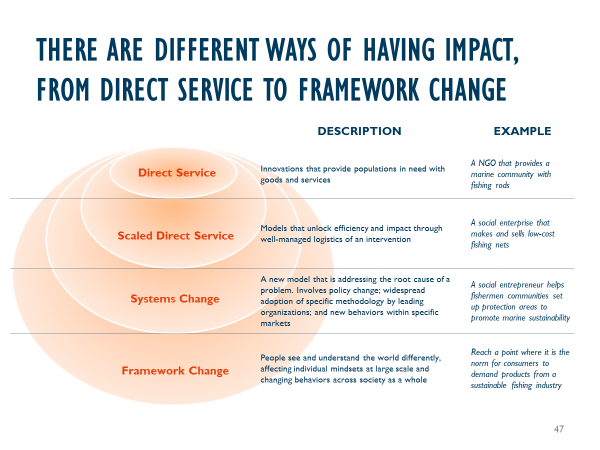
Diana Wells, Ashoka President, in the introductory and framing article, states that what matters most in determining a changemaker’s impact is not the size of one’s budget nor the number of those directly served. Rather measures of impact include: independent replication, public policy change, market change, and shifting mindsets, and can be measured, as seen in Ashoka’s image below, through direct service, scaled direct service, systems change, and/or framework change metrics. In other words, the most effective social entrepreneurs are those whose models help everyone be problem solvers. Ashoka defines itself through systems change and widespread framework change.
Returning to our question on whether the potential for good ideas to inspire more good ideas holds true and is it enough, we conclude that it is because it is stimulating the environment and context for all individuals to be problem solvers and changemakers. The journal challenges our academic and professional institutions to change not only the way they operate but the way they support young people and employees. People, despite their age or geographic location, need to know and feel what it means to co-lead teams and empower others to address a problem that they are experiencing. Peter Goldmark, former Publisher of the International Herald Tribune and former President of the Rockefeller Foundation once said, “Ashoka has shown how to invest successfully in pattern-breaking, powerful ideas and the people behind them -- and how to do so early when a little makes an enormous difference -- when hope can overcome cynicism, when tenacity can prevail over inertia. It has given us all the lessons in how to harness the most powerful energy in the world -- human talent -- to the task of adapting to the demands of the 21st century. We could not agree more.
Carol Sanford, in her most recent book: The Regenerative Business, agrees as she emphasizes that successful businesses today stop the practice of motivating people with incentives, rewards, and recognition, and shift to fostering initiative and self-management. She states that just important as technical skills, people need to develop a regenerative mindset defined by the fundamental characteristics of 1.) a desire to grow and improve, 2.) a motivation to engage and learn from others, and 3.) derive meaning from contributing to something larger than themselves.
We thank Diana Wells, Alessandro Valera, Sara Wilf, and Terry Donovan for the countless hours of curating and compiling their collective 40 years of experience, knowledge, and research into this edition which will be the driving force shaping how the global social sector approaches social innovation. We are inspired by Ashoka and because of their work we can imagine a world where Everyone is a Changemaker and where we all live in a Changemaker World.
We hope this edition will achieve our mission to inspire leaders and organizations to become changemakers; create the space for leaders to tap into their own creativity to innovate; empower leaders with the tools and knowledge to launch and grow their ideas; challenge leaders to become more empathetic; and transform everyone into a leader in a team of team’s world.
Yours in changemaking,
Nicholas Torres
Tine Hansen-Turton
SIJ Co-Founders
Published:
2026-02-18